Two Ways to Frame the Same Public Question
Learn to compare individual-choice and shared-conditions framings, so you can see which questions each raises without mistaking either for an answer.

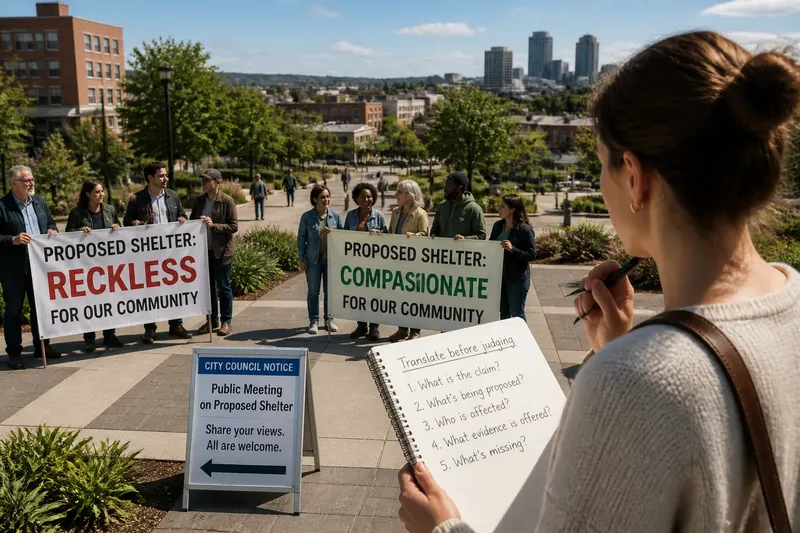
At a neighborhood meeting about missed medical appointments, one resident asks why people do not plan better; another asks why the clinic is difficult to reach. That difference is a framing choice. To compare individual-choice and shared-conditions framings, follow how each directs attention before deciding whether either explains the problem.
What is the question actually asking?
Begin by writing the public question in the plainest terms you can. For instance: “Why are residents missing appointments?” Avoid adding a cause before you have examined the wording. “Why are residents careless about appointments?” already places responsibility on patients; “Why are clinics inaccessible?” points toward conditions instead.
This first draft gives you something to compare. It does not have to settle the issue or cover every detail. Its purpose is to keep your later changes visible: you can see which part of the question shifts when the frame changes.
How does an individual-choice frame work?
Rewrite the question so that decisions, habits, knowledge, or priorities sit in the foreground. In the appointment example, ask: “What choices or routines contribute to missed visits?” This does not establish that patients are at fault. It identifies a possible line of inquiry about actions people can take.
Now list the questions this wording makes seem relevant. You might ask whether appointment reminders are noticed, whether people understand the clinic’s instructions, or whether they can rearrange plans when a visit is scheduled. These questions point toward a person’s options and decisions, including the constraints that shape those options.
Check whether the frame quietly assumes that everyone has the same information and freedom to act. A question about “better planning” may overlook unpredictable work hours, caregiving, limited phone access, or a confusing booking process. Keep the frame, but note which assumptions need checking rather than treating them as settled facts.
What changes in a shared-conditions frame?
Write a second version that places the surrounding circumstances in the foreground. For example: “What features of clinic access and scheduling make attendance difficult?” This points attention toward service hours, transit connections, booking rules, communication, and the location of care.
Again, list the questions prompted by the wording. Is the clinic reachable by available transportation? Do its hours fit common work schedules? Are instructions clear, and can a patient change an appointment without undue difficulty? These are questions about the conditions in which individual choices are made.
A shared-conditions frame can also carry assumptions. It may imply that a system feature is the central cause before anyone has examined patients’ circumstances or the actual pattern of missed visits. Treat it as a perspective that helps identify possible causes, not as evidence that one has already been established.
Which questions does each frame bring forward?
Place both versions side by side and compare their implied areas of attention. One may foreground a person’s knowledge, routine, or available choices; the other may foreground access, scheduling, or institutional arrangements. Neither list is automatically complete, and neither alone tells you what should change.
- Who is being asked to act? Does the wording direct attention to residents, service providers, employers, or another group?
- What could be observed? Name the information that might help distinguish a plausible explanation from an assumption.
- What stays outside the frame? Note circumstances that neither version mentions, such as caregiving responsibilities or communication barriers.
- What judgment does the wording suggest? Watch for language that turns a question about causes into a verdict about character or competence.
- What changes could the frame make imaginable? One may suggest better information or support; another may suggest changes to access or service design.
Imagine a local group is discussing missed appointments and has only a brief summary of the issue. It drafts “Why don’t patients keep their appointments?” then revises this to “What makes it hard for patients to attend scheduled appointments?” The first version invites questions about habits and reminders; the second also invites questions about timing, transport, and rescheduling. The observable result of the revision is a broader set of questions, not proof that any one cause is responsible.
That distinction is useful in public discussion. A frame can influence which experiences people are asked to describe and which explanations receive attention. It cannot, by itself, tell you which account fits the available evidence or whether a proposed response is fair.
How can you tell whether a frame has become a verdict?
Listen for a question that already contains its preferred answer. “Why are residents irresponsible?” treats a moral judgment as a premise. “Why does the clinic keep failing patients?” assigns blame to an institution before the relevant facts have been examined.
Try replacing the charged wording with a description that leaves more than one explanation open. “What contributes to missed appointments?” is less specific, so it may need follow-up questions, but it does not quietly decide where responsibility lies. The goal is not to make every issue sound neutral; it is to notice what a particular formulation assumes.
Also separate three things that public arguments often blur: a description of the problem, a claim about its causes, and a judgment about responsibility. Someone can agree that appointments are being missed while disagreeing about why. People can also share an explanation but differ over who should respond or what response is acceptable.
How can you use both frames without confusing them?
Keep the two versions visible as you read a report, listen to a meeting, or assess a public statement. Mark which claims concern individual decisions and which concern shared conditions. If a speaker moves from one kind of claim to another, ask what supports that shift.
Then look for the missing connection. A reminder system might matter only if people can receive and act on reminders; a service schedule might matter differently for people with different work arrangements. The point is not to force every issue into a tidy balance, but to see where personal choices and surrounding conditions meet.
Before treating either frame as the right one, ask what information would help answer the questions it raises. Depending on the issue, that might mean listening to affected people, examining how a service operates, or comparing accounts from different settings. Where the answer depends on local rules or specialized expertise, consult an appropriate professional or authoritative source.
What questions help compare the two framings?
Does an individual-choice frame mean blaming individuals?
No. It directs attention toward decisions and the options people perceive, but it does not establish that those decisions caused the problem or that blame is warranted. The circumstances shaping a person’s available choices still matter.
Does a shared-conditions frame remove personal agency?
No. It asks how surroundings and arrangements shape what people can do. Individuals may still make different choices within those conditions, and that possibility can be considered alongside them.
Which frame should I use when reading a public argument?
Use both as lenses, then notice which one the speaker relies on and what questions it leaves unasked. The relevant frame depends on the claim being examined and the information available, rather than on a fixed rule that one perspective must always prevail.
Can two different frames both be useful?
Yes, if each helps expose a distinct question and neither is mistaken for a complete explanation. Comparing them can show where an argument needs more evidence or a clearer account of responsibility.
When you encounter a public question, write its individual-choice version and its shared-conditions version before deciding which one is more convincing. That small pause makes the framing itself easier to see. It also leaves room for a more careful answer: one that distinguishes what people choose, what their circumstances allow, and what remains unknown.