Policy Goals and Policy Tools Are Different Things
Policy goals and policy tools are different things: separate the outcome a proposal seeks from its mechanism to compare arguments more clearly.

At a town meeting, a resident asks for a safer walk to the library. One person suggests a lower speed limit; another wants a raised crosswalk. The disagreement may sound like a dispute about safety, but both speakers could share the same policy goal and differ over the tool. Policy goals and policy tools are different things, and separating them helps clarify what a public argument is actually about.
What does a policy goal describe?
A policy goal is the change a government or public institution wants to bring about. It describes a desired condition: safer streets, fewer missed school days, cleaner air, or easier access to a service. A goal does not, by itself, say what rule, program, or public investment should be used.
Goals can be broad or narrowly defined. “Improve road safety” leaves room for several interpretations, while “reduce the risk of collisions near the library” points to a particular place and concern. A more specific goal can make evaluation easier, but it still does not settle which intervention is suitable.
Public statements often blur this distinction by expressing a tool as though it were the goal. “We need a new permit requirement” names a mechanism, not the ultimate result. Asking what change the permit is meant to produce gives readers a way to assess whether the proposed measure fits the stated purpose.
What counts as a policy tool?
A policy tool is the mechanism used to pursue a goal. Governments may use rules, public services, grants, taxes, information campaigns, procurement choices, or changes to the built environment. The tool is the means; the goal is the intended end.
The distinction is similar to wanting a room to be brighter and choosing a lamp. Brightness is the aim; the lamp is one possible means. A different room might need a window shade removed or a light fixture repaired. Choosing the object before describing the problem can lead people to argue about the lamp while overlooking what the room needs.
Tools also differ in who must act and how. A regulation may set a requirement for businesses or residents. A grant may help an organization take an action it could not otherwise afford. A public service may provide something directly, while an information campaign asks people to make a decision with better guidance. These mechanisms can point toward similar goals while involving different responsibilities and trade-offs.
Why do debates mix up ends and means?
Proposals are usually discussed through visible actions: a new rule, a budget line, a construction project, or a change in eligibility. The goal can be less visible because it is an intended future condition rather than something already being done. As a result, a debate may center on the tool before participants have established whether they agree on the problem it is meant to address.
There is also a political reason the language can become tangled. A speaker may describe a preferred tool as the only serious way to reach a broadly popular goal. Another may reject the tool and be heard as rejecting the goal itself. That conclusion does not necessarily follow. Someone can support safer streets while questioning a speed limit, or support better access to care while opposing a particular delivery model.
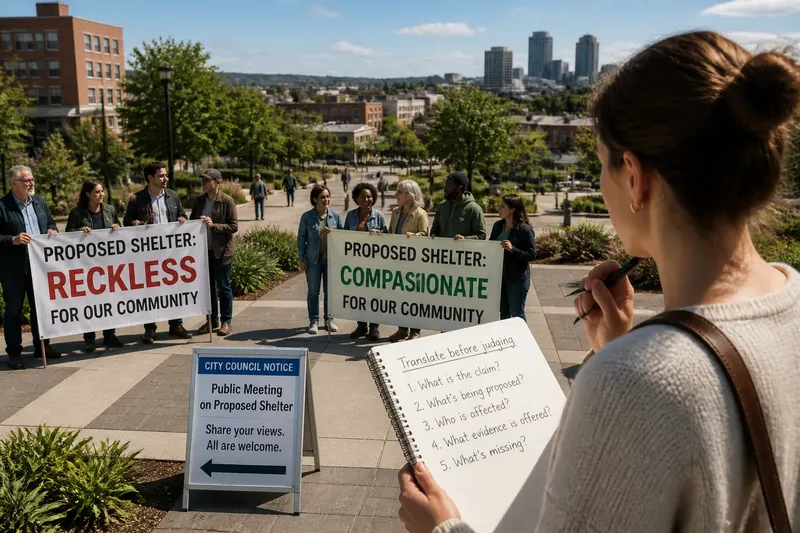
Keeping the two levels separate does not make every disagreement easy. People may genuinely differ about the desired outcome, the evidence used to identify a problem, or the values that should guide public choices. But naming the point of disagreement makes it harder to treat a challenge to one mechanism as proof of indifference to the underlying concern.
How can you tell which one an argument names?
Listen for the sentence’s main claim. A goal often describes a condition to improve or avoid: fewer dangerous crossings, more reliable access, less pollution. A tool often names an action or arrangement: install a signal, revise a rule, fund a service, or offer a rebate.
Some phrases can do either job depending on context. “Expand bus service,” for example, might be a tool for improving access, or it might be treated as the goal in a discussion about transit operations. To make the relationship clear, ask what result the action is supposed to produce and how that result would matter to the people affected.
Say a fictional town wants children to have a safer walk to its library. Its council considers a lower speed limit on the nearby street, while a group of residents prefers a raised crosswalk. The shared goal is a safer crossing; the two proposals are tools. The town could compare how each proposal addresses the location’s specific conditions, who would be responsible for it, and what changes residents would look for afterward, without assuming either proposal is automatically the right choice.
What questions help separate goals from tools?
What outcome is the proposal meant to change?
Translate the proposal into the condition its supporters want to improve or prevent. If the answer is unclear, the stated goal may be too broad to guide a meaningful comparison.
Who is expected to act, and by what mechanism?
Identify whether the proposal relies on a public agency, a business, a nonprofit, or individual residents. Then name the mechanism, such as a rule, service, grant, or public project, rather than treating “government action” as a single undifferentiated tool.
What would count as a sign of progress?
A goal becomes easier to discuss when people can describe an observable change that would indicate movement toward it. That sign need not prove that a tool caused the change; it simply helps keep the conversation tied to the stated purpose rather than to the proposal’s name.
Could another tool pursue the same goal?
Consider whether a different mechanism might address the same concern, perhaps with different burdens or responsibilities. This question does not require inventing alternatives for every proposal, but it reveals whether the debate is about the end, the chosen means, or both.
How should a tool be judged against its goal?
Start with fit: does the proposed mechanism plausibly address the problem named in the goal? A tool can be attractive in principle yet poorly matched to a specific setting. For instance, a public information campaign may help when people lack clear guidance, but it cannot by itself supply a service that is unavailable.
Next, examine the route from action to outcome. A proposal may depend on several links: an agency carries it out, affected people encounter it, and their circumstances or choices change in a way connected to the goal. If a key link is missing, supporters should explain how the tool is expected to work rather than relying on the goal’s appeal to carry the argument.
Then look at trade-offs and distribution. Who bears the cost, time, inconvenience, or risk of the tool? Who is likely to receive its benefits, and who might be left out? These questions do not replace the goal; they help determine whether the mechanism is acceptable and workable in light of it.
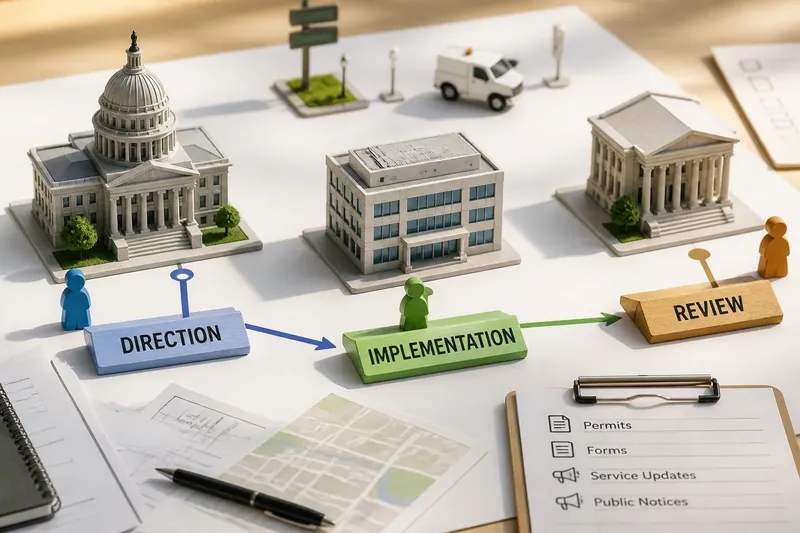
Finally, ask how decision-makers would learn whether the approach is serving its purpose. The answer may involve public reporting, feedback from affected communities, or a scheduled review. A review is not proof of success or failure on its own; it is a way to make room for adjustment if the tool and the goal have drifted apart.
Why does this distinction matter beyond one proposal?
Separating goals from tools makes public disagreement more precise. A person can say, “I support the intended outcome, but I do not think this mechanism fits the problem,” and then explain the concern. Supporters can answer by defending the tool’s connection to the goal, offering a different mechanism, or clarifying that the underlying goal is itself contested.
It also helps readers compare proposals that use different language. Two plans may sound unrelated because one describes a service and the other describes a rule, yet both might aim at the same outcome. Conversely, proposals that share a slogan may pursue different conditions or place responsibilities on different groups.
When you encounter a new public proposal, write down the intended condition in one phrase and the mechanism in another. That small distinction can show whether the argument concerns the destination, the route, or the people expected to travel it—and it gives the next question somewhere concrete to begin.