A Timeline for Following a Debate That Keeps Returning
A timeline for following a returning public debate helps you track its original question, changing frames, and decisions without collecting every headline.
You open a news alert about a debate you thought had settled, then find that the same arguments are back under a slightly different name. A timeline for following a returning public debate can show what actually changed: the question being asked, the terms used to describe it, and the decisions that shifted its course.
The aim is not to preserve every headline or settle the issue. It is to keep a small, durable record that lets you distinguish a fresh development from a familiar argument—and see when a genuinely new question has entered the discussion.
What belongs on a timeline for following a returning public debate?
Record only the points that change how the debate can be understood. A useful entry usually contains a date or clearly stated period, a short description of the event, and a note about why it matters to the debate’s direction.
For a public issue, a timeline may include the initial question, a proposal, a change to the proposal, a decision by an institution, a court ruling, a new piece of evidence, or a shift in who has authority to act. It need not include every speech, interview, or reaction. Those can be useful sources, but they are not automatically turning points.
Think of the timeline as a kitchen drawer, not a storage unit: keep the tools you reach for, and leave out the packaging. A brief record is easier to revisit and less likely to bury the important change beneath a pile of updates.
How do you identify the debate’s original question?
Start with the earliest clear statement of the problem that prompted public attention, not with the first article you happen to find. Ask what people were trying to decide, prevent, provide, or change, and write that question in plain language.
Keep the original question separate from the proposed answer. “Should the city restrict through-traffic on this street?” is a question; “install a barrier” is one possible response. That distinction helps you notice later when a debate shifts from whether action is needed to which action is acceptable, who should pay, or who gets to decide.
If the issue has no single starting point, say so. Use a provisional entry such as “Public discussion becomes visible around…” and identify the source or event that makes that point a useful beginning. A timeline does not have to claim that a complicated issue began on one exact day.
Which changes in framing are worth recording?
Record a change in framing when it alters what people seem to be arguing about, whose interests are foregrounded, or what counts as a satisfactory answer. A debate about whether a service should exist may later become a debate about eligibility, cost allocation, local control, or access.
Make the difference visible by writing the earlier and newer formulations side by side. For example: “Is the service needed?” becomes “Who qualifies for it?” Avoid treating every new slogan as a new frame. The phrase matters when it reorganizes the question, not merely because it sounds different.
Be careful to distinguish a speaker’s framing from the position of an entire group. Attribute language to the person, agency, campaign, or document that used it. If several sides use different descriptions, note that disagreement rather than choosing one description as neutral.
What counts as a decision that changes the debate?
A decision matters when it changes what can happen next, who has authority, or what choices remain open. A formal vote, an agency rule, a court ruling, a funding decision, or an official withdrawal of a proposal may each alter the debate’s path.
Separate decisions from announcements and predictions. An official may say that a measure is under consideration without adopting it; a proposal may pass one stage while still awaiting another. Describe the status precisely: proposed, approved by a named body, blocked, revised, delayed, or in effect, as appropriate.
Also record the scope. A decision may apply only to a particular agency, location, group, or period. The details can explain why a debate returns: the decision resolved one part of the question while leaving another unsettled.
How should you record uncertainty and disagreement?
Mark what is known, what is disputed, and what remains unresolved instead of forcing one clean story. A timeline can be accurate while acknowledging that participants disagree about causes, consequences, or the meaning of a decision.
Use compact labels in your notes, such as “official action,” “claim by supporters,” “objection,” or “not yet decided.” Then attach a source that allows you to check the entry. For an institutional action, the institution’s own notice or decision document is often a sensible starting place; for a claim about an argument, preserve the speaker and context.
Do not quietly convert a forecast into an outcome. If someone predicts that a policy will have a certain effect, record it as a prediction and revisit it only when a relevant result or later decision appears. Where the status depends on a document, manufacturer instructions, or local rules, check the applicable source; in public-policy disputes, the responsible institution’s current materials are usually the place to verify procedural status.
How can you keep the record useful without following every update?
Use a short entry template and update it only when a new item changes the timeline’s meaning. A plain text note, spreadsheet, or document table is enough; the tool matters less than being able to locate the entry and its source later.
- Date or period: Use the date shown by the source, or describe the timing as approximate when it is unclear.
- Event: State what happened in one sentence, with the institution or speaker named.
- Question or frame: Note what the debate was asking before and what it asks now, if that changed.
- Decision status: Distinguish an adopted action from a proposal, promise, or unresolved matter.
- Why it matters: Explain what options, authority, or affected groups changed.
- Source: Keep a link or document title and enough context to find it again.
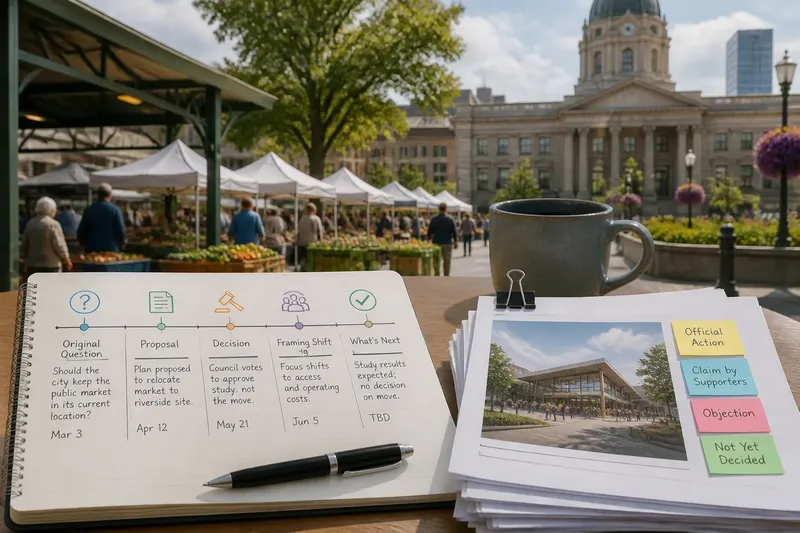
Imagine you are following a fictional city debate over a public market. Your first entry records the question of whether the market should remain in its current location. Later, a proposal to move it shifts attention to access and operating costs; a council vote then approves a study, not a move. The timeline would preserve that distinction, so a later headline saying “market relocation approved” would prompt you to check what the vote actually authorized.
What should you do when the debate returns?
Compare the new development with the last entry before adding it. Ask whether the original question has returned, whether the framing has changed, whether a decision has been made, or whether a familiar argument is simply being repeated.
If nothing has changed, add no entry—or note briefly that the issue has resurfaced without a new decision. If something has changed, update the timeline with the specific shift and leave earlier entries intact. Rewriting the past to make the sequence appear tidier can hide how the debate moved.
A returning debate may also have acquired a new boundary. A later proposal might concern a different group, a different location, or a narrower authority than the one discussed before. Preserve that difference rather than treating the new episode as a replay.
Which questions help you check your timeline?
How many entries should a public-issue timeline have?
Keep enough entries to show the original question, meaningful changes in framing, and decisions that altered the available choices. If several updates repeat the same position without changing the issue’s status, they can stay out of the main timeline.
Should headlines be used as timeline entries?
Headlines can help you locate an event, but they often compress or dramatize its status. Check the article or primary document, then describe the underlying event in your own neutral wording and preserve the source.
How do you handle a debate with several starting points?
State that the beginning is contested or gradual, and choose a clearly explained point for the timeline’s practical starting place. You can include earlier context in a short note without pretending that one event created the whole issue.
When is it time to stop updating the timeline?
Stop active updates when new coverage no longer changes the question, framing, decision status, or affected parties. Keep the record available and resume it if an action or new frame changes what the debate is about.
How can a timeline prevent a false sense of closure?
End each entry with the status that remains open, when there is one. A decision can close a procedural question while leaving the underlying dispute intact; saying which part was settled and which part remains live keeps the record honest.
For a timeline for following a returning public debate, that distinction is the lasting value: it gives you a way to recognize both repetition and change. When the next alert arrives, you can check what was asked before, what has since been decided, and what the latest development actually adds.